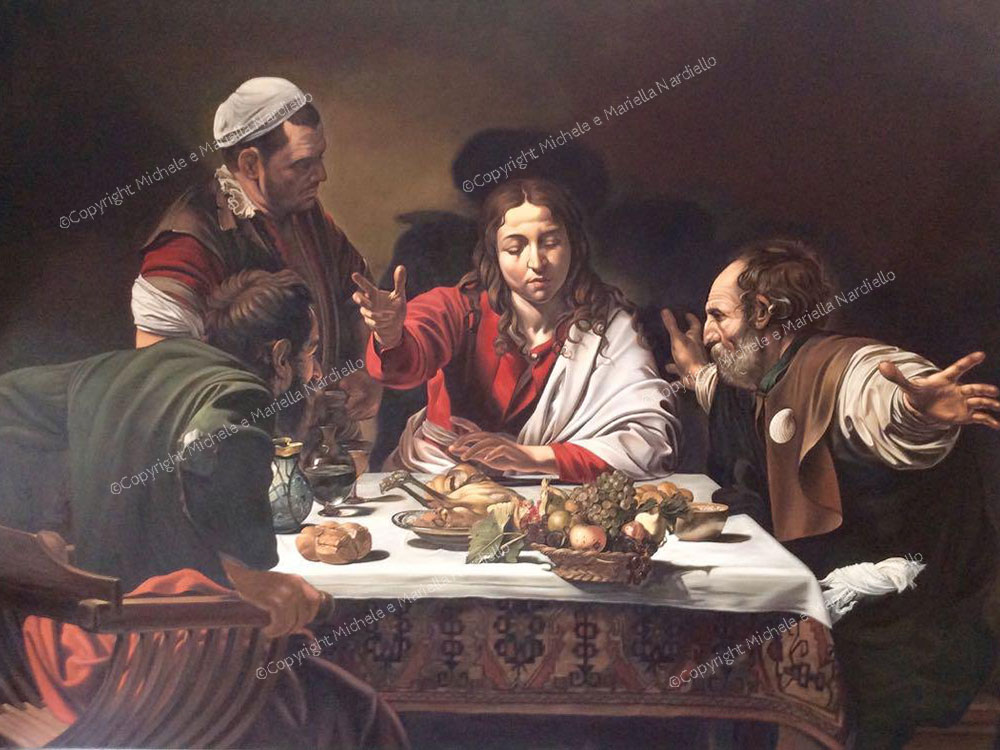
Il quadro a olio su tela la cena di emmaus di michele nardiello replica la scena in cui gesù risorto si rivela a due discepoli.
Soggetto e composizione: il dipinto ritrae il momento in cui cristo, seduto al centro a tavola, benedice il pane. I tre commensali e l’oste (in piedi) sono disposti attorno al tavolo in una composizione ravvicinata. I discepoli sono colti di sorpresa, uno ha le braccia spalancate, l’altro si sporge incredulo verso cristo.
Realismo e dettagli: l’opera è famosa per il suo realismo e la copia riproduce con esattezza i dettagli della natura morta sul tavolo, tra cui un cestino di frutta che sporge dal bordo.
Luce e drammaticità: la scena è illuminata da una luce frontale che si riflette sull’incarnato di cristo, sulla fronte calva di uno dei discepoli e sul cibo. Questo chiaroscuro accentua il momento e mette in risalto il colore rosso della veste di cristo, elemento principe della composizione.
La copia di michele nardiello è una riproduzione che enfatizza il gesto rendendo l’originale di caravaggio una rivoluzione nella pittura sacra.
michele nardiello’s oil on canvas replicates the scene in which the risen jesus reveals himself to two disciples at emmaus.
Subject and composition: the painting depicts the moment when christ, seated in the center of the table, blesses the bread. The three diners and the innkeeper (standing) are arranged around the table in a close-up composition. The disciples are taken by surprise; one has his arms outstretched, the other leans in disbelief toward christ.
Realism and details: the work is renowned for its realism, and the copy accurately reproduces the details of the still life on the table, including a basket of fruit protruding from the edge.
Light and drama: the scene is illuminated by a frontal light that reflects on christ’s complexion, the bald forehead of one of the disciples, and the food. This chiaroscuro accentuates the moment and highlights the red of christ’s robe, the composition’s key element.
michele nardiello’s copy is a reproduction that emphasizes the gesture, making caravaggio’s original a revolution in sacred painting.